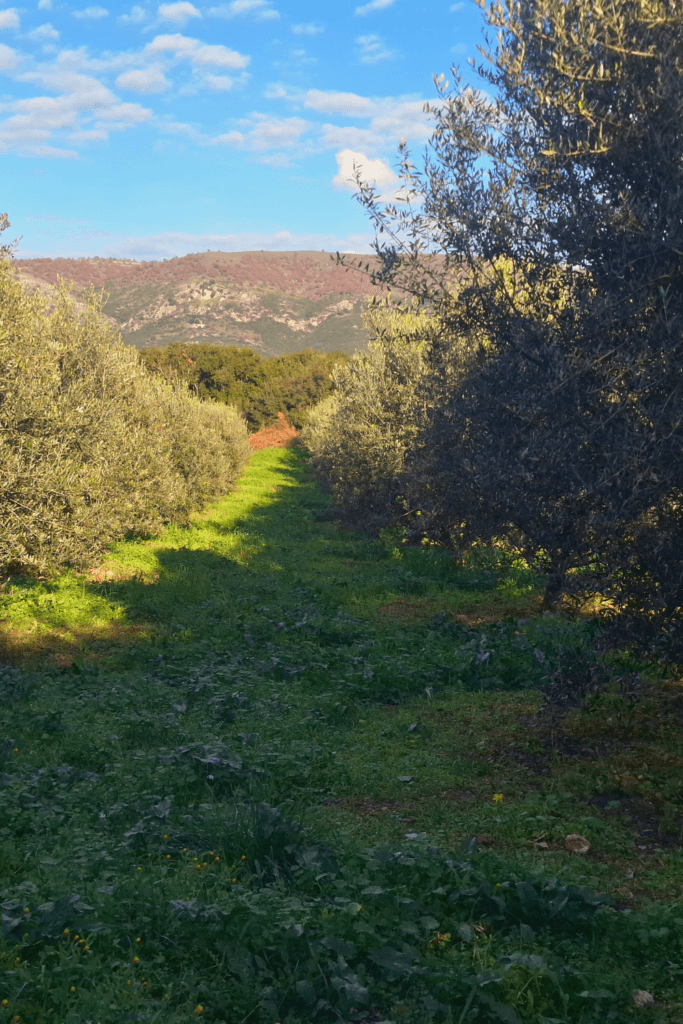
The sun hasn’t fully risen over Katouna yet, but Apostolos Maltezos is already walking through his olive groves, coffee in hand, inspecting the morning dew on the leaves. It’s 6 AM, his favorite time of day. The trees are silent witnesses to a decade-long transformation that began with a single vision: prove that exceptional olive oil can come from farming that heals the land rather than depletes it.
Today, those 420 Koroneiki olive trees produce some of Greece’s finest extra virgin olive oil. But ten years ago, this land told a very different story.
The Land His Father Gave Him
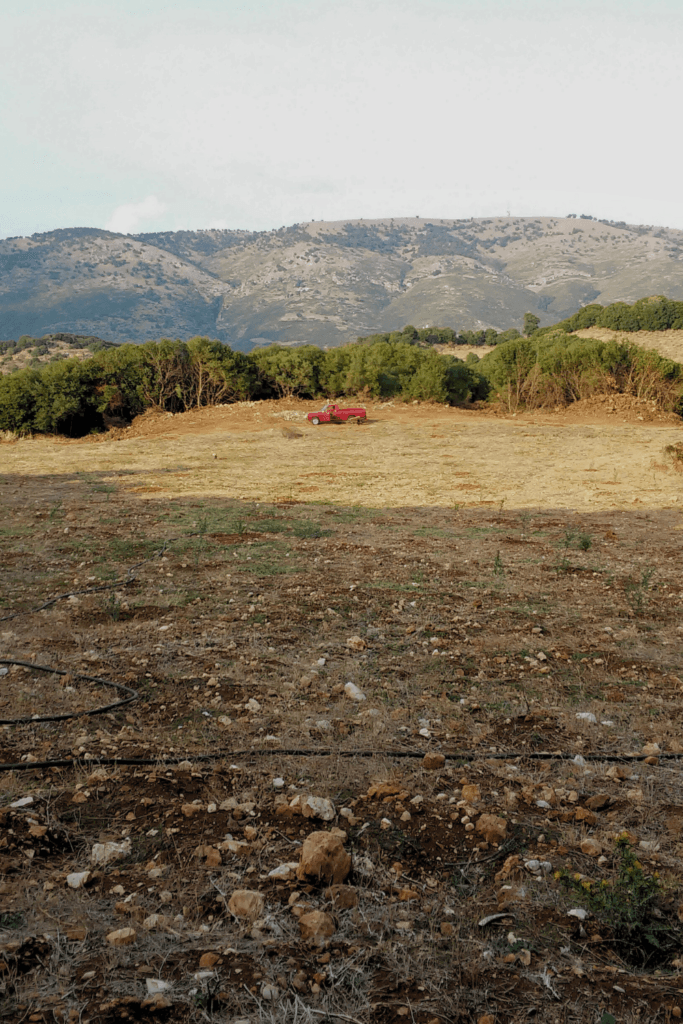
In October 2016, Apostolos stood on his father’s fields in Katouna, Aetolia-Acarnania, the same village where he was born and raised. The soil beneath his feet had once grown tobacco, like most land in this region. His family had been tobacco farmers for generations. But Apostolos, fresh from completing his MSc in Agronomy at the University of Thessaly, saw something different when he looked at this earth.
“I imagined the trees as they would look in ten years,” he recalls. “And I imagined the olive oil in a bottle.”
It wasn’t a business plan. It was simpler than that: he wanted his family to have their own olive oil, to know exactly what they were eating, to control the quality from soil to table. What he didn’t realize was that this modest goal would become a mission.
Why Olive Oil?
The decision was rooted in science, not sentimentality.
“This tree fits the soil and microclimate of the area,” Apostolos explains, his agronomist training evident in every word. “Not other crops.”
He’d studied the data. Western Greece faces heavy rains and high humidity, conditions that destroy many crops but that the Koroneiki variety thrives in. Koroneiki is resistant, productive, produces exceptional quality oil, and has minimal alternate bearing (the tendency of olive trees to produce heavy crops one year and light crops the next).
But there was another reason, one he discovered as a child.
“My uncle used to take me to the fields when I was young, showing me the land, the tractor, how things grew,” Apostolos remembers. “And in the forest near our land, there were wild olive trees, αγριελιές, growing strong. I knew then: if wild olives can thrive here naturally, cultivated ones will flourish.”
His family was supportive. The villagers? Not so much.
“People in the village expressed their doubts,” he says with a slight smile. “They thought the trees wouldn’t survive in this land. But I knew they would. The wild olives proved it.”
October 2016: Planting 420 Trees
Apostolos planted all 420 trees himself, alongside his father, with his mother helping where she could. Every single one.
It was backbreaking work, but it was also an education. “You learn things from planting that no university can teach you,” he says. “How the soil feels. How deep the roots need to go. The exact angle of the trunk.”
But within three to four months of planting, disaster struck.
An ice freeze descended on Katouna, the most dangerous threat to young olive trees. If newly planted trees freeze, you can lose everything.
“We scrambled to find anti-freeze materials to cover the young trees,” Apostolos recalls, the memory still vivid. “It was a race against time. That was the hardest moment of the first nine years, watching something you’d just created face destruction before it even had a chance to grow.”
The trees survived. Barely.
Then came the wild grass. The sheep that broke through and ate the single-branch saplings. The summer droughts. The constant battle of the first years.
“In the beginning, you need to be super careful, pruning, feeding, protecting. If you make a mistake in those early years, the trees don’t develop properly. Everything compounds.”
What the Land Taught Him
Apostolos learned regenerative agriculture not from a trendy book, but from a conversation with a professor at the University of Thessaly.
“He introduced me to the concept during my studies,” Apostolos says. “But I really understood it from the land itself.”
The principle became clear through observation: the land knows best.
“It has its own rhythm,” he explains. “If you work alongside the land and not against it, everything works as it should. And your final product will be of optimal quality.”
He tracks everything: soil tests, leaf tests, growth rates, observations, research. His weekly routine in the groves is meticulous, guided by the core principles of soil science he learned at university and through constant self-study.
But the most important metric isn’t in the data.
“Good farming means producing something safe and beneficial to humans, but without hurting nature,” Apostolos says. “That’s the standard. Conventional agriculture focuses on high yields using synthetic inputs and heavy tillage, often degrading the soil. Regenerative agriculture prioritizes ecosystem health, no-till, cover cropping, techniques that improve soil health, biodiversity, and carbon sequestration.” After four years, he saw the first real results. The trees were thriving!
What Keeps Him Going
When asked what motivates him through the exhausting harvest days, the relentless summers, the freezing winters, Apostolos’s answer is immediate.
“The vision of Medéleon. The personal effort I’ve put in. The hours of studying I’ve spent.”
But there’s something deeper. “I want to leave a legacy for my kids,” he says quietly. “Unlike my parents, who worked the land but didn’t own the story of what they grew. I want my children to inherit something that’s entirely ours, something we built with science, with respect, with our own hands.”
“Creating exceptional olive oil isn’t about shortcuts, it’s about honoring the entire process. From the moment we plant a tree to the second we seal a bottle, every decision is guided by one question: How do we maximize both quality and integrity? The answer is always the same: through science, patience, and respect for nature.”
— Apostolos Maltezos
Agronomist and Founder of Medéleon
MSc in agriculture crop production and rural environment, University of Thessaly